
Electrical performance and mechanical reliability often depend on components that receive little attention during the initial design phase. PCB bus bars must efficiently distribute high-current with minimal voltage drop, while stiffeners reinforce printed circuit boards and flexible circuits to prevent bending, vibration damage, and assembly-related failures.
E-Fab manufactures custom precision-etched PCB bus bars, electrical busbars, circuit board stiffeners, and specialty reinforcement components for demanding electronic applications. Using advanced photochemical etching, we produce burr-free, stress-free metal components with intricate geometries that are difficult or costly to manufacture using traditional machining or stamping methods.
Whether you’re developing a high-current power distribution system, reinforcing a rigid-flex PCB, or designing a complex electronic assembly, our engineering team works closely with you to manufacture components optimized for your electrical, mechanical, and manufacturing requirements.
Each component is manufactured to customer specifications, allowing engineers to optimize geometry, thickness, hole patterns, electrical performance, and assembly integration for virtually any application.
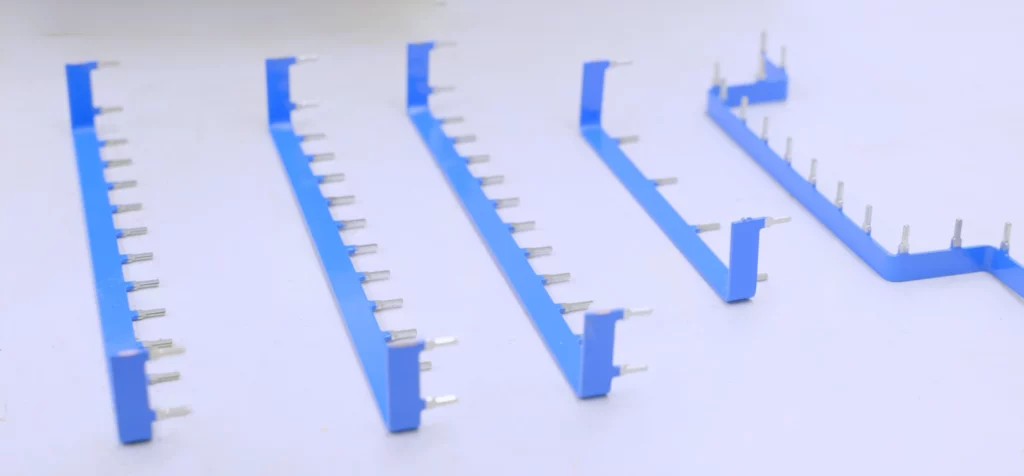
A PCB bus bar is a conductive metal component designed to distribute electrical power throughout a printed circuit board or electronic assembly. Rather than relying solely on copper traces to carry large amounts of current, bus bars provide a low-resistance pathway capable of handling significantly higher current loads while minimizing voltage drop and heat generation.
Busbars are commonly fabricated from copper or copper alloys because of their excellent electrical conductivity, although other materials may be selected based on environmental conditions, corrosion resistance, or mechanical requirements.
Unlike conventional wire harnesses or oversized PCB traces, a custom PCB busbar gives engineers greater flexibility when routing power through compact assemblies, helps reduce electromagnetic interference in sensitive circuits, and improves overall electrical efficiency.
These advantages make busbars an ideal solution for applications requiring consistent electrical performance, high-current transfer, and long service life.
Standard PCB traces are suitable for many electronic circuits, but as current requirements increase, wider copper traces consume valuable board space and may still generate excessive heat due to electrical resistance; for example, a 1 mm wide, 10 cm long PCB trace has 50 mΩ resistance.
A custom bus bar addresses these limitations by providing a dedicated current path with substantially greater cross-sectional area than conventional traces. Even when thicker PCB cladding can reduce voltage drop by half, a bus bar still provides a dedicated lower-resistance path for higher-current designs. This allows power to be distributed more efficiently while maintaining a compact PCB layout.
Compared to heavy copper PCBs alone, busbars offer several additional advantages:
For power electronics, industrial controls, battery management systems, telecommunications equipment, and high-current embedded electronics, busbars often provide a more robust and scalable solution than relying exclusively on printed copper circuitry.
No two electrical systems distribute power in exactly the same way. Current requirements, available space, mounting constraints, insulation requirements, and connection methods vary significantly between applications.
E-Fab manufactures custom busbars engineered around each customer’s design requirements, including:
Because photochemical etching removes material chemically rather than mechanically, engineers can incorporate intricate features without introducing burrs, distortion, or residual stresses that may affect electrical performance or assembly fit.
Our custom busbars support reliable power distribution across a wide range of industries and electronic systems, including:
Whether carrying low-voltage, high-current power, handling high-currents, or serving as a dedicated ground bus within a complex assembly, each busbar is manufactured to meet the performance requirements of its intended application.
While PCB bus bars are designed to optimize electrical performance, PCB stiffeners provide the mechanical reinforcement necessary to protect electronic assemblies throughout manufacturing, installation, and field operation.
As printed circuit boards become thinner and more densely populated, they are increasingly susceptible to flexing, twisting, and localized stress. These forces can lead to cracked solder joints, damaged components, connector misalignment, and premature product failure. Precision stiffeners help distribute these loads across the assembly, improving structural integrity without significantly increasing weight or package size.
At E-Fab, we manufacture custom metal PCB stiffeners engineered to reinforce rigid, flexible, and rigid-flex circuit assemblies while meeting exact dimensional and assembly requirements.
A PCB stiffener is a precision reinforcement component attached to a printed circuit board or flexible circuit to increase rigidity in targeted areas. Rather than strengthening an entire assembly, stiffeners reinforce specific locations where mechanical loads are concentrated, such as:
By reducing localized flexing, stiffeners help maintain electrical continuity and extend the service life of electronic assemblies operating in demanding environments.
Mechanical stress is one of the leading contributors to electronic assembly failures. Even slight board deflection during assembly or operation can create long-term reliability issues that may not become apparent until after deployment.
Custom stiffeners help engineers address these challenges by:
For electronics exposed to shock, vibration, thermal cycling, or repeated servicing, properly designed stiffeners can significantly improve overall product durability.
The performance of a bus bar or stiffener depends on more than its material selection. Manufacturing method plays a significant role in dimensional accuracy, edge quality, assembly fit, and overall reliability.
Unlike stamping, machining, or laser cutting, photochemical etching (PCM) removes metal chemically rather than mechanically. Because the process introduces no cutting forces or heat-affected zones, intricate features can be produced without deforming thin materials or altering their mechanical or electrical properties.
For engineers developing precision electronic components, this translates into greater design freedom and improved manufacturability.
Mechanical fabrication methods often leave burrs or sharp edges that require secondary deburring operations. These additional processes increase manufacturing time and introduce variability.
Photochemical etching produces naturally burr-free edges, helping ensure:
For PCB bus bars and precision stiffeners, burr-free edges also help prevent insulation damage and improve overall assembly quality.
Modern electronic assemblies rarely consist of simple rectangular components.
Engineers frequently require:
Photochemical etching reproduces these geometries directly from digital artwork, allowing intricate features to be manufactured simultaneously across the entire sheet without custom hard tooling.
This flexibility enables rapid design iterations while minimizing development costs.
Traditional punching or stamping can introduce residual mechanical stresses that affect flatness and dimensional stability.
Photochemical etching avoids:
The result is a precision component that maintains its intended geometry throughout manufacturing and assembly.
Product development rarely ends with the first revision.
Engineers often require multiple prototype iterations before releasing production designs.
Because photochemical etching uses digital tooling rather than expensive hard tooling, design revisions can be implemented quickly, reducing lead times and accelerating product development.
This makes the process ideal for:
Whether producing ten parts or tens of thousands, E-Fab maintains the same focus on precision, repeatability, and quality.
Material selection plays a critical role in both electrical and mechanical performance. Current requirements, corrosion resistance, operating temperature, weight, and forming characteristics all influence the optimal material for a given application.
E-Fab manufactures custom components from a wide variety of engineering metals.
Copper remains the industry standard for PCB bus bars because of its exceptional electrical conductivity, making it ideal for high-current power distribution while minimizing voltage drop and resistive heating.
Typical applications include:
Brass offers a balance of electrical conductivity, corrosion resistance, and machinability, making it suitable for electrical hardware, terminals, and specialty bus bar applications where moderate conductivity and mechanical strength are required.
Beryllium copper combines high conductivity with excellent spring properties, fatigue resistance, and mechanical strength. It is commonly used in demanding electronic applications requiring both electrical performance and resilience under repeated loading.
Although not typically used for primary current-carrying bus bars, stainless steel is an excellent material for structural stiffeners because of its high strength, corrosion resistance, and dimensional stability.
Applications include:
Nickel-based materials provide outstanding corrosion resistance and elevated-temperature performance for specialized electrical and industrial applications operating in aggressive environments.
Depending on application requirements, E-Fab also manufactures components from additional alloys selected for conductivity, magnetic properties, corrosion resistance, or weight reduction. Our engineering team can recommend the most suitable material based on your electrical, mechanical, and environmental requirements.
Precision-etched bus bars and PCB stiffeners support some of today’s most demanding electronic systems. Whether improving current distribution, reinforcing sensitive assemblies, or reducing overall package size, these components play an important role in product reliability and long-term performance.
E-Fab partners with OEMs, contract manufacturers, and engineering teams to produce custom components tailored to each application’s electrical, mechanical, and manufacturing requirements.
Electronic products continue to increase in functionality while decreasing in size, creating greater demands on power distribution and mechanical stability. Precision bus bars and stiffeners help engineers overcome these challenges by improving electrical efficiency, reducing thermal issues, and reinforcing assemblies subjected to repeated handling or vibration.
Common applications include:
Whether integrated into a prototype or a high-volume production assembly, custom-etched components provide consistent quality and repeatability from build to build.
Power conversion and energy storage systems require conductors capable of carrying substantial current while minimizing voltage drop and resistive heating. Precision bus bars provide efficient electrical pathways that improve system performance and simplify assembly compared to complex wire harnesses.
Typical applications include:
By replacing bulky wiring with engineered bus bars, designers can optimize packaging while improving electrical performance and serviceability.
Weight, reliability, and repeatability are critical considerations in aerospace and defense electronics. Components must withstand vibration, shock, thermal cycling, and extended operating life without compromising performance.
E-Fab manufactures lightweight precision-etched components used in:
Photochemical etching enables complex geometries without introducing mechanical stresses that could affect dimensional stability or long-term reliability.
Modern communication systems rely on dependable power distribution across increasingly compact assemblies. Precision bus bars help improve current flow while supporting higher power densities and efficient thermal management.
Applications include:
Semiconductor production equipment demands precision components capable of operating in tightly controlled environments. Custom bus bars and structural components support power delivery and mechanical stability throughout advanced manufacturing systems.
Applications include:
Medical devices and laboratory equipment require consistent electrical performance, compact packaging, and exceptional manufacturing quality. Custom bus bars and stiffeners help maintain system reliability while supporting miniaturized designs.
Typical applications include:
Selecting the right manufacturing partner is just as important as selecting the right manufacturing process. E-Fab combines decades of photochemical etching expertise with collaborative engineering support to help customers move efficiently from concept to production.
Photochemical etching has been E-Fab’s core competency for decades. Our process is optimized for manufacturing intricate metal components that demand tight dimensional control, fine features, and repeatable quality.
Compared to conventional fabrication methods, photochemical etching offers several advantages:
This process enables engineers to design for performance rather than manufacturing limitations.
The most successful projects begin long before production starts.
Our engineering team works directly with customers to review the design plan for manufacturability and performance, and evaluate:
Early collaboration helps identify potential manufacturing challenges before they become costly design revisions, reducing development time and accelerating product launches.
Design iterations are a natural part of product development. Because photochemical etching relies on digital tooling, engineering changes can often be implemented quickly without the lead times or tooling costs associated with stamping or machining.
Whether you require:
E-Fab provides a scalable manufacturing solution that supports your product throughout its lifecycle.
Manufacturing domestically provides advantages beyond logistics. Customers benefit from responsive communication, shorter lead times, consistent quality standards, and closer collaboration throughout every phase of a project.
E-Fab supports customers across North America with precision manufacturing backed by experienced engineers, dependable production processes, and a commitment to long-term partnerships.
A PCB bus bar is a precision metal conductor that distributes electrical power throughout a printed circuit board or electronic assembly.
Bus bars are typically preferred when multiple power connections must be handled beyond the practical limits of PCB traces, or when power distribution requires lower resistance or simplified assembly.
A PCB stiffener reinforces targeted areas of a printed circuit board or flexible circuit to reduce flexing, improve connector stability, and protect solder joints from mechanical stress.
E-Fab manufactures custom components from a wide range of engineering alloys, including copper, brass, beryllium copper, stainless steel, nickel alloys, and other specialty metals; material and bus bar layers are selected to match the electrical and mechanical needs of the application, along with specific environmental requirements.
Photochemical etching produces burr-free, stress-free components without introducing heat-affected zones, while supporting compliance-driven designs developed to IPC expectations when required.
Prototype lead times vary depending on material selection, complexity, and quantity.
Whether you’re designing a high-current power distribution system, reinforcing a rigid-flex PCB, or developing a next-generation electronic assembly, E-Fab delivers precision-etched components engineered for performance, manufacturability, and long-term reliability.
Our team works closely with engineers and procurement professionals to develop custom bus bars, PCB stiffeners, and specialty metal components that integrate seamlessly into demanding applications. From rapid prototypes to production-scale manufacturing, we help transform complex designs into repeatable, high-quality parts.
If you’re looking for a manufacturing partner with deep expertise in precision photochemical etching, E-Fab is ready to support your next design.
Upload your drawings for a detailed manufacturing review and competitive quotation.
Collaborate with our engineering team to optimize your design for manufacturability, performance, and cost.
Accelerate development with precision-etched prototypes that transition seamlessly into full-scale production.