
Photochemical Etching: What It Is, How It Works, and When to Use It
Photochemical etching is a precision metal manufacturing process used to produce complex, burr-free components with extremely fine detail, without heat, mechanical force, or tool wear. It is a high-precision, subtractive manufacturing process that uses photo-sensitive resist, UV light, and chemical etchants to selectively remove material from metal sheets.
The chemical etching process and chemical machining are both used to fabricate precision metal components, and the photo chemical machining process is a modern alternative to traditional fabrication methods. By combining photoresist imaging with controlled chemical reactions, photochemical etching enables repeatable, high-accuracy parts that would be difficult or cost-prohibitive to manufacture using conventional methods. Photochemical etching is a cost-effective and scalable machining process, suitable for both rapid prototyping and high-volume production, due to the lack of hard tooling requirements.
E-Fab provides a comprehensive, engineering-focused explanation of photochemical etching, how the process works step by step, the equipment and materials involved, and how it compares to alternative manufacturing technologies. It is intended as a foundational technical resource for engineers evaluating manufacturing options early in the design process.
What Is Photochemical Etching?
At E-Fab, Photochemical etching is at the core of our competencies, a specialized subtractive metal manufacturing process that selectively removes material from a metal sheet using chemical etchants and patterned photoresist masks. E-Fab’s tailored chemical etching process, also known as chemical machining, utilizes etchants to dissolve specific areas of the metal, allowing for the production of highly precise and intricate metal components. Combined with E-Fab’s commitment to quality, this method is designed to meet exact requirements for precision metal parts, accommodating complex geometries and various material hardness levels without deformation.
Photochemical etching is also commonly referred to as:
- Photo etching
- Chemical etching of metals
- Chemical milling
- Photochemical machining (PCM)
E-Fab maintains strict control of process variables, such as etchant concentration and temperature, and an unwavering commitment to our craft, is essential to ensure consistent results in the chemical etching process.
Why Photochemical Etching Is Used in Precision Manufacturing
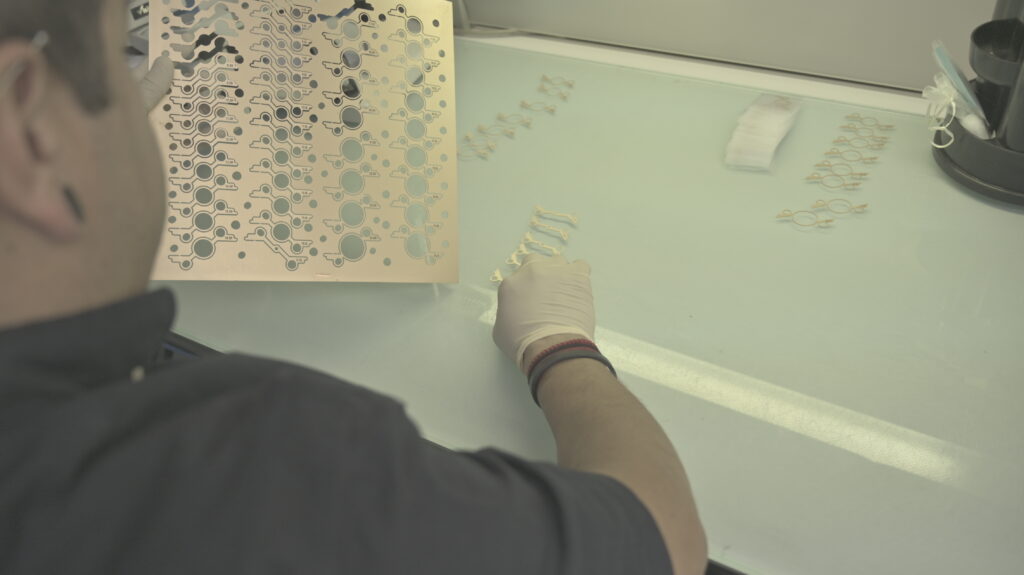
Unlike cutting or forming processes, E-Fab’s photochemical etching relies on chemical reactions rather than physical force. This allows engineers to:
- Create intricate geometries and fine features
- Maintain tight dimensional consistency
- Avoid heat-affected zones or work hardening
- Produce flat, stress-free parts suitable for sensitive applications
- Rapidly prototype and manufacture complex parts and precision parts, especially for thin-gauge sheet metal
Photochemical etching does not require hard tooling, making it a cost-effective and fast solution for producing complex and precision parts, often within days.
Photochemical etching is especially valuable when part complexity is high, tolerances are critical, and material integrity must be preserved.
How Photochemical Etching Works
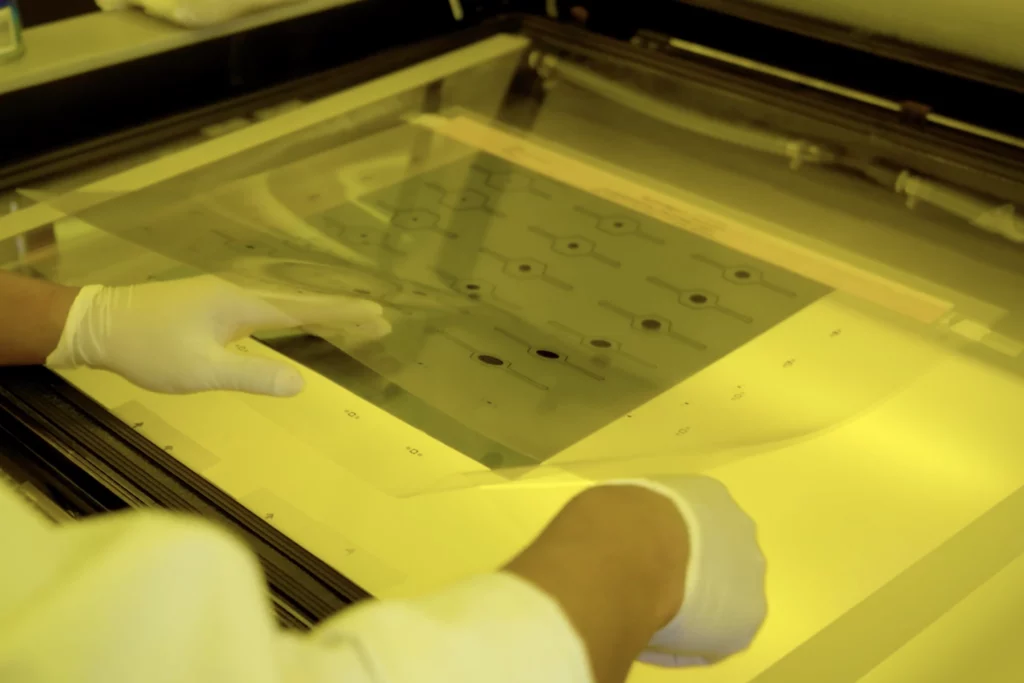
At a high level, the photochemical etching process transfers a digital design onto metal using a photosensitive material, typically a photoresist, to create the desired pattern on the metal sheet. The photoresist is applied as a protective mask, and a mask or phototool containing the desired pattern is used to ensure accurate transfer after UV light exposure.
The process follows three core principles:
- Imaging – A photoresist defines where material will remain
- Selective Etching – Chemistry removes only unprotected areas
- Precision Control – Process parameters determine accuracy and repeatability
The cleanliness of the metal substrate and the uniform application of photoresist are critical for achieving consistent results, especially when forming intricate designs. Additionally, process variables, such as temperature, etchant concentration, and agitation, must be carefully controlled throughout the process to ensure consistent and precise outcomes.
Along with our decades of experience, this combination enables high-resolution patterning at scale, from rapid prototypes to full production runs.
Chemical etching is a multi-step process that uses carefully formulated chemicals to create designs on flat metal sheets.
Due to the precision it delivers, highly complex and intricate designs can be produced on various metals. Despite its complexity, the process itself is fast and affordable, making it an excellent choice for metal prototyping and production.
The general process for chemical etching includes the following steps:
Photo Tooling
- The first step in metal preparation involves using CAD software to transfer an engineer’s digital drawing onto mylar film, which transposes the part images onto the metal.
Exposing
- During the chemical etching metal process, each sheet of metal is laminated with a photoresist film. Using the phototool, UV lamps expose the image of the part onto the photoresist coated substrate.
Coating
- It’s in this stage that clean, flat sheets of metal are coated with a polymer called photoresist. Applied to both sides of the coated metal sheet, the polymer is UV light sensitive and acid resistant. A vacuum seal is applied between the top and bottom layers of the phototool to seal in the coated sheet of metal.
Developing
- Using a developing machine, an alkaline solution is used on the sheets of metal to wash away the top and bottom film.
Etching
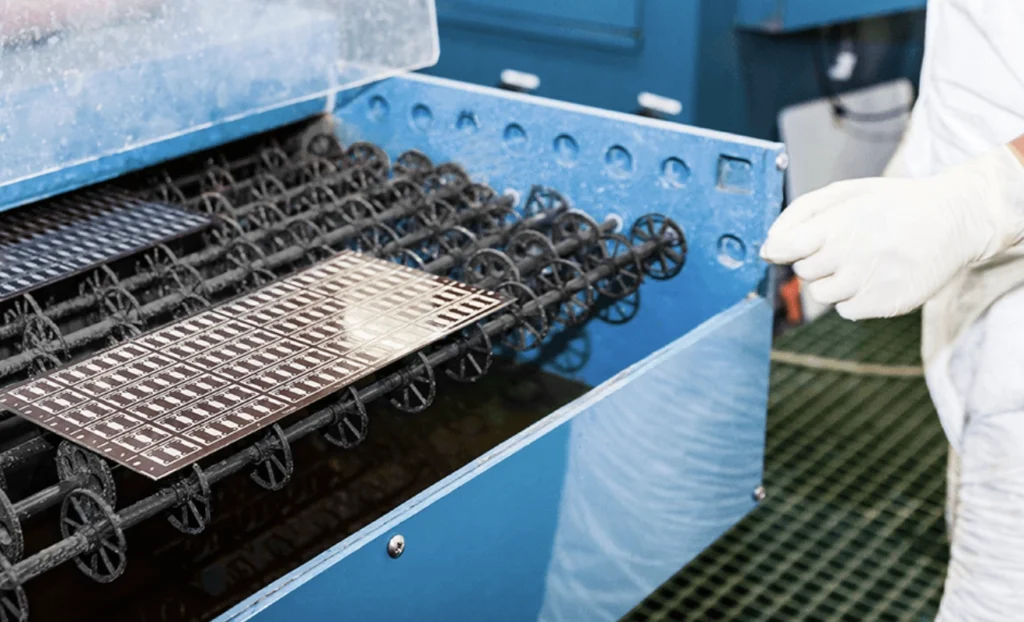
- The metal sheets are fed through an etcher that etches away the uncoated areas, leaving the precisely defined features of the part
Stripping
- To strip the mask from the metal surface, an alkaline solution is used. The etched sheets are dropped in a tank which removes the remaining photoresist film.
Forming
- In some cases, forming presses are used to bend the etched blank into precise three-dimensional shapes.
Inspection
- In order to ensure that your part meets your specifications, calibrated measuring instruments and state-of-the-art inspection machines are used. The part’s surfaces, dimensions and tolerances need to be inspected and approved during this final stage.
Step-by-Step Photochemical Etching Process
Material Selection
The process begins with selecting a metal alloy compatible with photochemical etching and suitable for the application. Material thickness, grain structure, and chemical resistance all influence final results.
Photochemical etching is limited to thin-gauge metals, typically 1.5 mm or less, making it ideal for applications requiring fine detail on thin materials.
Cleaning and Surface Preparation
Metal sheets are thoroughly cleaned to remove oils, oxides, and contaminants. Proper surface preparation ensures uniform photoresist adhesion and consistent etching performance. Thorough cleaning ensures a smooth surface, which is essential for the uniform application of photoresist and sets the foundation for the success of subsequent etching stages.
Photoresist Application
A light-sensitive photoresist, which is a photosensitive material, is applied to one or both sides of the metal sheet using precision coating systems. The resist thickness is carefully controlled based on material type and etch depth requirements.
Uniform application of the photosensitive material is critical to producing consistent, high-quality results when forming intricate designs on the metal.
Imaging and Exposure
High-resolution photo tools containing the desired pattern of the part geometry are aligned with the coated metal. UV light exposure hardens the photoresist in specific areas, transferring the desired pattern onto the sheet.
Developing the Resist
Unexposed photoresist is chemically developed and removed, revealing bare metal in areas intended to be etched while protected regions remain intact.
Chemical Etching
The metal passes through spray etchers where a controlled etchant, such as ferric chloride, selectively dissolves the exposed metal. This machining process requires careful control of variables like conveyor speed and etchant concentration to achieve precise results. Etching occurs uniformly across the sheet thickness, producing smooth, burr-free edges. However, the etchant can sometimes undercut the edges of holes, which may lead to dimensional inaccuracies if not properly controlled.
Resist Stripping and Finishing
After etching, the remaining photoresist is stripped away. Additional finishing steps, such as passivation, plating, or forming, may be applied depending on application requirements.
Inspection and Quality Control
In the final stage of the photochemical etching process, all parts are inspected to ensure they meet the client’s exact requirements. Final parts undergo inspection using optical measurement systems and metrology tools to verify dimensional accuracy, feature fidelity, and overall consistency. During this stage, the process’s ability to achieve high-precision tolerances (as low as 0.001” or 10µm) and intricate geometries is thoroughly verified.
Photochemical Etching Equipment
Photochemical etching equipment refers to integrated industrial systems designed for precision manufacturing, not off-the-shelf machinery. These systems provide a comprehensive solution for both small-scale laboratory applications and high-volume production, with equipment that can be linked together to form continuous production lines. Masteretch systems are specifically designed to operate at maximum efficiency and for long-term use in high-volume production environments.
E-Fab’s key equipment lineup that supports our capabilities includes:
Photoresist Coaters
Automated systems that apply uniform photoresist layers with tight thickness control.
UV Exposure Systems
High-resolution exposure units that accurately transfer digital designs to photoresist.
Etching Machines and Spray Etchers
Continuous or batch systems, such as conveyorized etching machines, often use ferric chloride as the etchant to selectively dissolve metal in patterned areas. These systems deliver controlled chemical reactions across metal surfaces.
Chemistry Control Systems
Closed-loop chemistry control systems monitor and adjust process variables such as etchant concentration, temperature, and flow rates to ensure consistent etch performance.
Inspection and Metrology Tools
Optical measurement, vision systems, and dimensional inspection tools ensure quality and repeatability.
Materials Used in Photochemical Etching
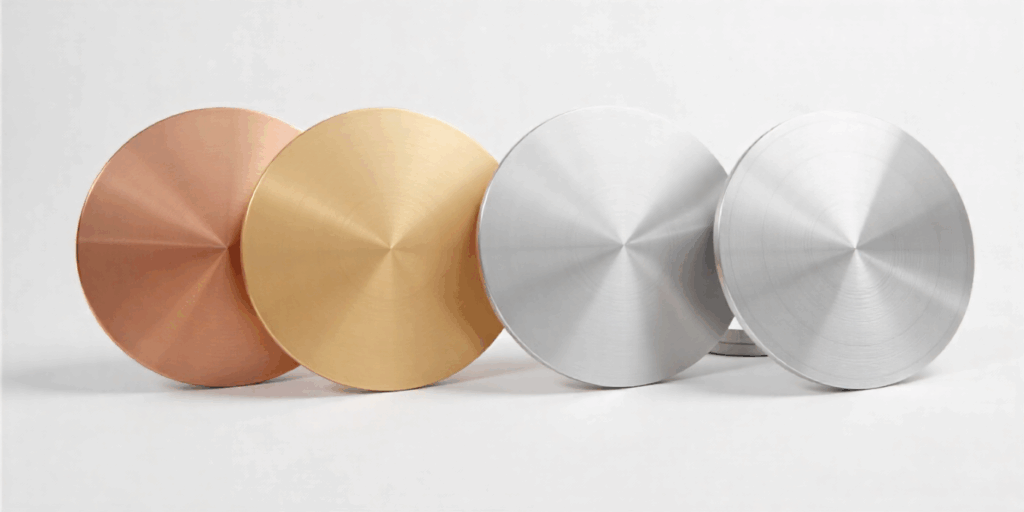
Photochemical etching supports a wide range of metals and alloys, including:
- Stainless steel
- Copper and copper alloys (brass, bronze)
- Nickel and nickel alloys
- Titanium
- Aluminum
- Specialty and high-performance alloys
This process is especially well-suited for thin-gauge sheet metal, which is commonly used in high-precision applications. The ability to precisely etch thin sheet metal makes photochemical etching ideal for industries requiring fine, detailed components.
Material choice affects etch rates, achievable tolerances, and final part performance.
Design Considerations for Photochemical Etching
Tolerances and Feature Sizes
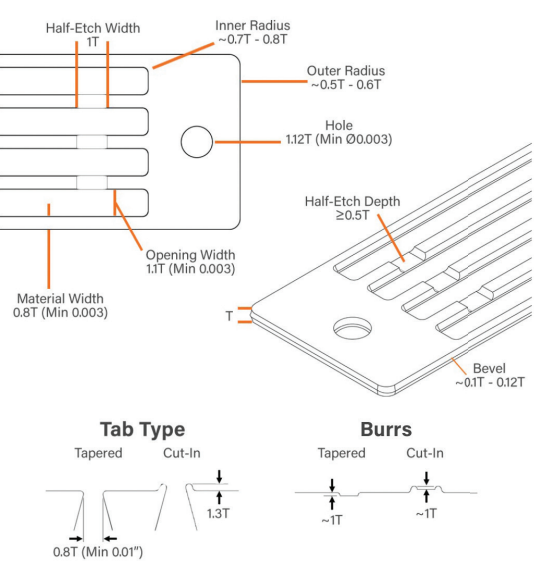
Tolerances depend on material thickness, feature geometry, and etch depth. Photochemical etching excels at fine features relative to material thickness.
Etch Factor and Undercut
Etching occurs laterally as well as vertically. Understanding the etch factor is essential for accurate design compensation.
Thickness Limitations
The process is best suited for thin to medium gauge metals, typically from foil thicknesses up to several millimeters. However, photochemical etching is limited to relatively thin metals, typically 1.5 mm or less. Additionally, photochemical machining is a 2D process and cannot be used to produce 3D parts.
Double-Sided Etching
Etching from both sides allows for thicker materials and more complex geometries.
Part Geometry and Layout
Flat parts with intricate internal features, tight spacing, or delicate structures are ideal candidates.
Advantages of Photochemical Etching
- No heat-affected zone
- No burrs or mechanical stress
- Cost-effective complexity
- Fast prototyping and design iteration
- High consistency across production runs
- No hard tooling required, making photochemical etching a cost-effective solution for producing complex parts with intricate features.
- Rapid turnaround: photochemical etching can produce parts quickly, often within days, compared to weeks for traditional manufacturing methods.
Because tooling is digital rather than mechanical, design changes can be implemented quickly without retooling costs.
Common Applications
Photochemical etching is widely used across high-performance industries for components such as:
- EMI/RFI shields
- RF components
- Precision apertures and meshes
- Springs and flexures
- Medical device components, including precision parts like stents and filter meshes for the medical industry
- Small, complex parts for automotive applications
- Photonics and optical assemblies
Photochemical Etching vs. Other Processes
Photochemical etching is a modern fabrication method for sheet metal, utilizing the photochemical machining process to produce high-precision components. This process offers unique advantages over traditional methods, such as enhanced accuracy, minimized lead time, and scalability, making it ideal for high-tech industries.
Photochemical etching is often evaluated alongside other manufacturing methods, including:
- Laser cutting
- CNC machining
- Metal stamping
- Wire EDM
Each process has advantages depending on part geometry, material thickness, and production volume. See our Blog for additional deep dives into process comparisons.
Why Working With E-Fab Makes the Biggest Impact
Successful photochemical etching depends on more than chemistry, it requires deep process control, material expertise, and collaborative engineering support, the foundation on which our team at E-Fab not only prides itself but holds itself accountable to maintaining that commitment.
We are a U.S.-based specialist in metal photochemical etching, supporting customers across aerospace, medical, photonics, electronics, and defense industries. At E-Fab, we provide a comprehensive solution for precision metal fabrication and etching processes, and are capable of handling both high and low volume production efficiently. With extensive experience in etched metal components, E-Fab’s team of experts works closely with your organization’s engineering teams to optimize designs for manufacturability, precision, and cost efficiency.
From early-stage prototypes through full production, E-Fab provides consistent results backed by rigorous process control and quality systems.